
Wise County Court Calendars Explained
Start with the Wise County daily docket. It is a one-day schedule, not a case history. Each row pairs a cause number with a type, case style, judge, time, and proceeding. District felony and major civil matters can appear beside county-law misdemeanor, probate, or family settings. So the type and judge tell you which court controls the event.
The county-linked Odyssey selector also advertises a Court Calendar route. That route leads to a login screen. No open guest access is guaranteed. Treat the daily docket as a first check only. The case record and the court coordinator offer stronger confirmation. Justice of the Peace and municipal court dates sit on separate local calendars.
One more thing. The official Wise County dockets page carries a key local notice. A setting labeled status review or nisi review does not require an appearance on that date. Other setting types may require action. Read the exact label and the most recent court notice before you skip anything.
Six Wise County Docket Columns
The public daily list answers six basic questions at a glance. Cause number identifies the file. Type sorts the matter into a broad case group. Style is the formal caption. Judge names the judicial officer. Time gives the scheduled hour. Proceeding explains why the matter is on the Wise County court calendar that day.
The official daily docket source shows each of these six fields for every listed setting. Avoid copying private party details from a live calendar into unrelated notes.
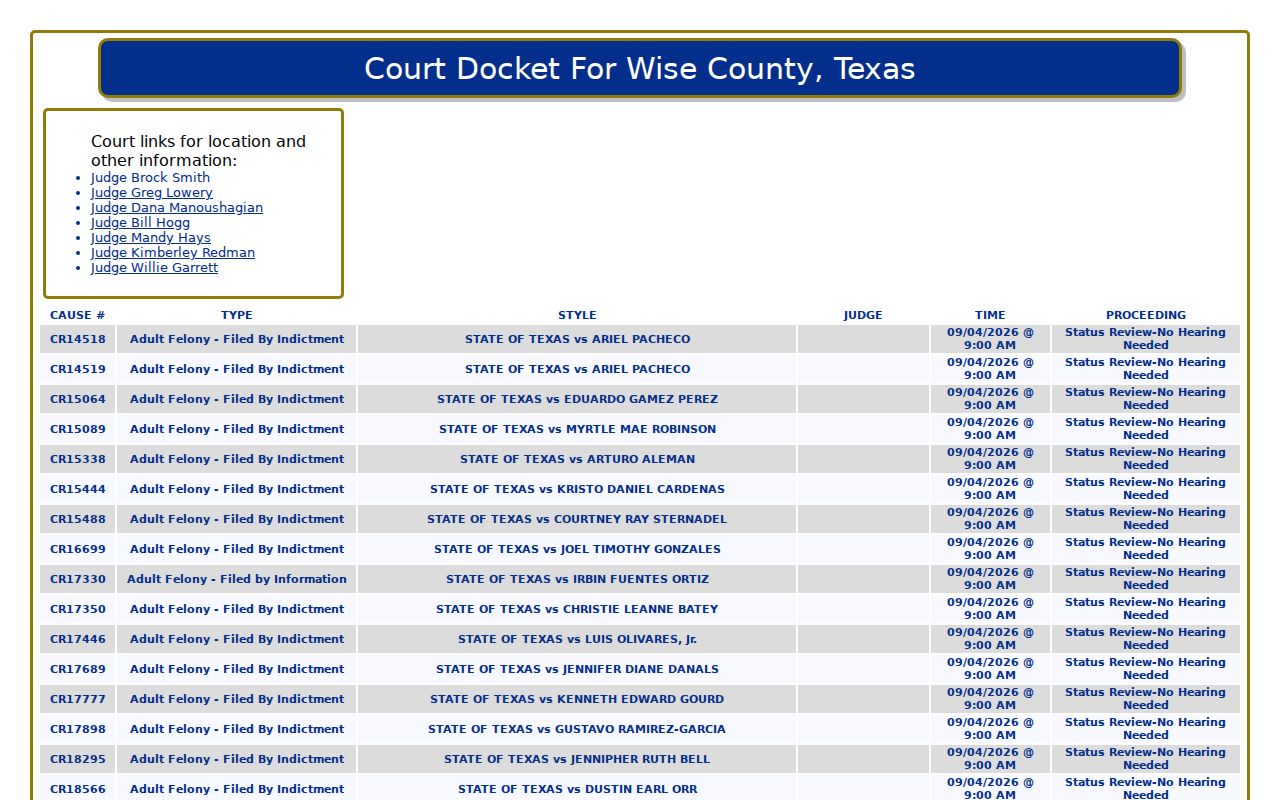
This view shows why the cause number is the best bridge from a short calendar row to a fuller court record. It also reveals the limits of the public display. The six columns include no separate courtroom field and no reset history.
Finding Your Court Date
Begin with the paper that names the court. That may be a citation, an order, or a hearing notice. Use the exact cause number whenever you have it. Names and styles can change or produce close matches, but the clerk-assigned cause number follows one file.
- Read the notice for the court name, cause number, and stated setting.
- Check the Wise County daily docket and the Odyssey Court Calendar selection. For a broader search, use re:SearchTX and choose Hearings.
- Compare the calendar row with the newest hearing entry in the case detail. Do not rely on an old row after a reset or continuance.
- Call the proper court coordinator when the setting is generic, the room is missing, or two dates conflict.
- If online access fails, contact the responsible clerk by phone, mail, or at the counter. Ask whether a public courthouse terminal is available before making the trip.
Attorneys and parties should compare the public row against the notice served in their own case. A mailed or electronic setting notice may carry details the public Wise County court calendar omits. Lower-court traffic matters belong with the issuing Justice of the Peace or municipal clerk, not the District Clerk by default.
Which office you call depends on the question. Calendar questions go to the coordinator. Docket entries and copies go to the clerk. The District Clerk neither schedules nor changes hearings. Neither office is a channel for private contact with a judge.
Wise County Court Date Lines
Wise County publishes separate direct lines for its main trial calendars. The 271st Judicial District Court coordinator sits at 940-627-3200. County Court at Law No. 1 uses 940-627-5005. County Court at Law No. 2 uses 940-683-0268. When the public docket leaves a trial or hearing setting unclear, these lines can confirm the current date.
271st District Court
District felony, civil, family, and juvenile calendar questions
940-627-3200
County Court at Law No. 1
Misdemeanor and county-level calendar questions
940-627-5005
County Court at Law No. 2
Probate, guardianship, family, and civil calendar questions
940-683-0268
Staff assignments can change, so check the official court contact grid before calling. Municipal and Justice Court dates still need confirmation with that local court itself.
Note: Ask about the current setting and courtroom, but direct file-copy questions to the clerk who maintains the case record.
How to Read a Court Setting
A setting is one scheduled step, not the whole case. The Wise County daily docket may use a precise term such as arraignment or motion hearing, or it may just say hearing. Match the row to the cause number before drawing any conclusion from the style or type alone.
| Date | The day of the displayed daily docket or the date stated in the newest case hearing entry. |
|---|---|
| Time | The listed start time. Confirm whether it is an individual appointment or a shared docket call. |
| Courtroom | Not a separate field on the visible daily table. Confirm the building and room with the coordinator. |
| Judge | The judge shown for the setting, which helps route a question to the right court. |
| Setting Type | The proceeding column, such as arraignment, plea, motion hearing, announcement, trial by judge, or status hearing. |
| Cause Number | The clerk-assigned key used to open the linked case record and distinguish similar captions. |
A posted date is not a certified notice. The table does not guarantee a hearing stays active after a later order. Use the newest entry, and if the row and a served notice disagree, contact counsel or the coordinator promptly.
Wise County Court Setting Labels
Local proceeding labels describe the task scheduled for that day. They do not state the final outcome. A dismissal docket, for example, is a setting used to process dismissals. It does not prove every listed matter was dismissed. An open plea marks a plea setting whose terms need confirmation from the case record or the court.
- Arraignment
- A criminal appearance dealing with the charge, rights, and plea-stage matters.
- Announcement
- A status setting used before a later trial or disposition.
- Motion hearing
- A setting for the court to hear a filed request for a ruling.
- Docket call
- A calendar call used to organize cases for trial or later settings.
- Continuance or reset
- A postponement or new setting that requires checking the newest entry.
Other Wise County labels include plea, trial by judge, violation of probation, final divorce, expunction, and a generic hearing. The label gives context. Only the current record and the court notice establish what a participant must actually do.
Continuances, Resets, and Cancellations
A continuance pushes a setting back. A reset picks a new date. Either way, read the change against the full list of case events. The public daily table keeps no universal reset history. It leaves old rows standing. A newer notice or order can control even while an older calendar view stays online.
Criminal jury matters follow Wise County local Rule 5.13, which calls for a final docket call before the jury setting. Pretrial motions generally must be filed more than seven days before that final docket call unless the rule or court says otherwise. That sequence explains why one case can show announcement, pretrial, docket call, and trial as four separate dates.
Weather, holidays, and office closures can shift things too. County pages carry current notices, but no single permanent calendar governs every Wise County court. Confirm any closure with the specific coordinator. A closed office does not cancel a hearing unless the court itself confirms it.
Wise County Court Setting Notice
One Wise County rule stands apart. The county dockets page states a simple rule. Status review and nisi review settings do not require appearance on the date shown. That instruction covers only those two settings, and it should never be stretched to arraignments, pleas, trials, or motion hearings. Follow the exact notice tied to your case.
The official posted notice and docket route come straight from the county. That page shows how Wise County treats the special status-review and nisi-review settings.
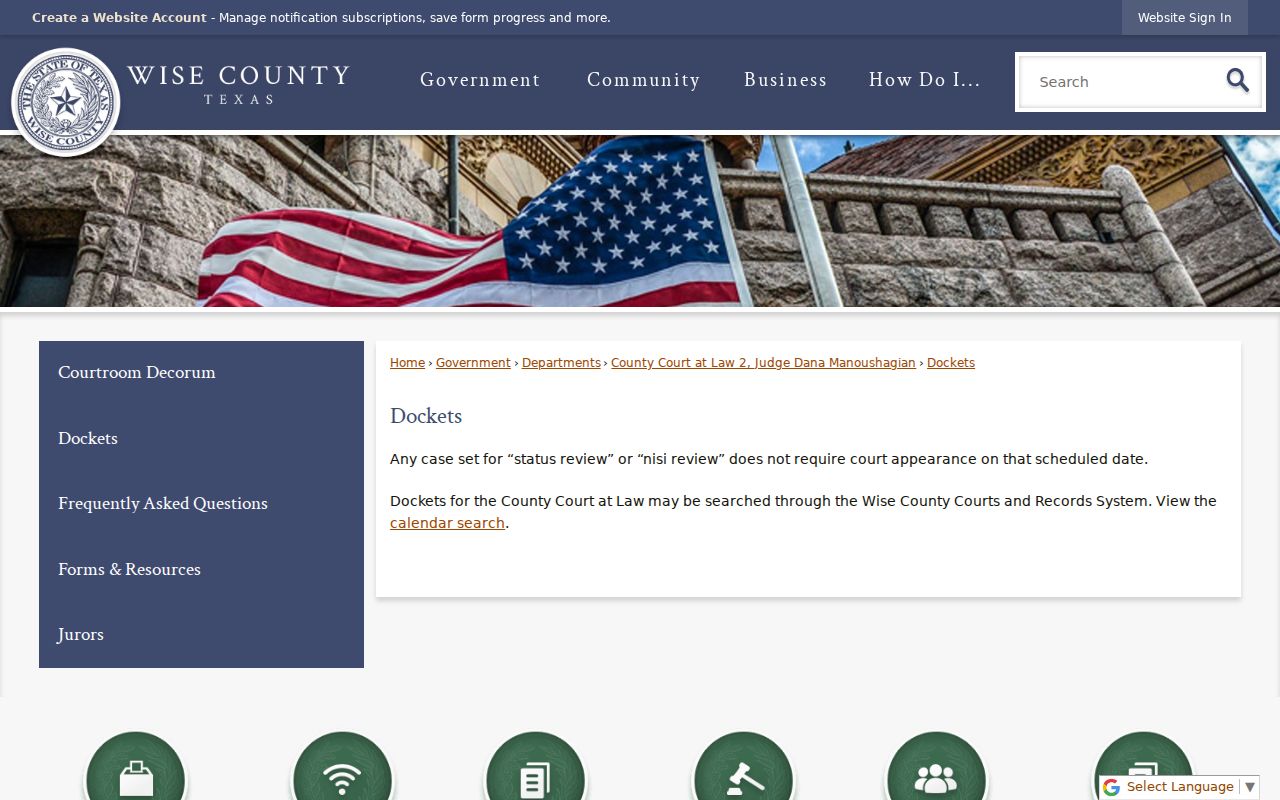
The distinction matters in practice. One locally named review setting may not call for attendance. Another proceeding still might. When unsure, quote the proceeding label and cause number to the court coordinator.
If You Miss a Court Setting
Act promptly. Check the newest Wise County court docket entry. Then contact counsel and the correct court office. Ask whether the judge entered an order, issued a new date, or requires an appearance. The clerk can explain what public entries exist. The clerk cannot give legal advice or quietly change the court calendar.
Missed a setting? A missed required appearance can lead to a warrant, bond action, dismissal, default, or another court response depending on the case.
Contact the responsible court at once, use the cause number, and ask what the current record and setting show.
Seek advice from a licensed attorney about the proper response before making assumptions or appearing without instructions.
A missed civil setting and a missed criminal appearance can lead to different results. So can a city citation and a district case. Don't send every matter to one office. The correct venue controls the remedy, and a quick case lookup helps identify that venue before you call.
Wise County Lower-Court Calendars
Four Justice of the Peace courts and several municipal courts keep their own lower-court calendars. A traffic citation, eviction, small claim, or city ordinance matter may never appear as a district setting. The paper that issued the citation names the court. JP1 and JP2 serve Decatur-area matters, JP3 sits in Boyd, and JP4 is in Bridgeport.
City access differs as well. Decatur posts a municipal docket. Rhome publishes a schedule. Boyd posts court notices plus a docket location. Bridgeport and Runaway Bay use their own municipal channels. The county Odyssey calendar is not a universal city-ticket calendar. Start with the issuing court.
For the record behind a date, the contextual Wise County case lookup walks through the county and statewide search layers. Even with a public result in hand, a court date stays subject to the latest order and notice.
Note: A lower-court date belongs to its JP or municipal clerk unless the record shows a transfer or appeal.