
Searching Wise County Civil Dockets
Know the court before you type a name. The Wise County Odyssey selector lists Civil, Family & Probate Case Records. It also offers a separate Court Calendar. The live request now redirects to a login, so a session may be needed. Even so, a login wall is not proof that a file is confidential.
For the strongest results, search by cause number. The Wise County daily docket itself tells readers to carry that identifier into Civil Case Records. If a name is all you have, re:SearchTX covers party and attorney fields, wildcards, court location, case type, the Cases and Hearings menus, added filters, sorting, and export.
- Classify the matter as district, county-law, probate, family, or justice-court civil.
- Select Civil, Family & Probate Case Records, or choose Wise County in re:SearchTX.
- Search the unchanged cause number first, then supported party fields if needed.
- Open the style and read filings, settings, orders, and results in date order.
- Request the exact judgment or docket sheet from the correct clerk for certification.
Offline fallbacks still work. The District Clerk or County Clerk can help at the counter, by phone, by mail, or through a detailed written request. Each Justice of the Peace clerk keeps its own small civil docket. And an old case may need a paper index, microfilm, or a search of archived files rather than yet another spelling of the name.
Wise Civil Courts Split the Work
Civil work in Wise County is split among several offices. The District Clerk keeps the district civil and family files, while the County Clerk handles county-level civil and probate work. County Court at Law No. 2 hears mainly probate, guardianship, family, and civil matters, and County Court at Law No. 1 carries both county criminal and civil roles. Eviction, small-claims, debt, and repair cases belong to the justice courts.
| Court | Civil docket slice | Contact |
|---|---|---|
| 271st District Court | Major civil and family matters | District Clerk, 940-627-5535 |
| County Court at Law No. 1 | County civil and related matters | 940-627-5005 |
| County Court at Law No. 2 | Probate, guardianship, family, civil | 940-683-0268 |
| Justice Courts 1-4 | Eviction, small claims, debt, repair | Issuing precinct clerk |
Municipal court rarely hosts a contract, property, probate, or family dispute. When a search comes up empty, the fix may be venue, not spelling. Switching from the District Clerk to the County Clerk, or to the right precinct, often solves what a name variation cannot.
Inside a Wise Civil Docket
The public daily calendar is lean. It shows cause, type, style, judge, time, and proceeding, and nothing more. A full civil docket can add parties and their roles, attorneys, filing dates, service returns, motions, orders, hearing history, judgment, and appeal data, though which fields appear varies by court and access level.
| Cause number | The clerk key shown as CAUSE #; do not invent or normalize a format. |
|---|---|
| Case type | A category such as accounts/contracts/notes, eviction, divorce, parent-child relationship, or small claims. |
| Style | The formal caption identifying the parties. |
| Events | Filed petitions, returns, answers, motions, notices, signed orders, and judgments. |
| Settings | Announcement, status, motion, pretrial, trial, or final hearing entries. |
| Disposition | Final judgment, agreed judgment, nonsuit, default, DWOP, or another court-entered result. |
A docket entry only proves the event was recorded. The filed image may not be attached to it. Open the linked document when access allows, or ask the clerk for the actual pleading or signed order.
Wise CCL2 Civil and Probate
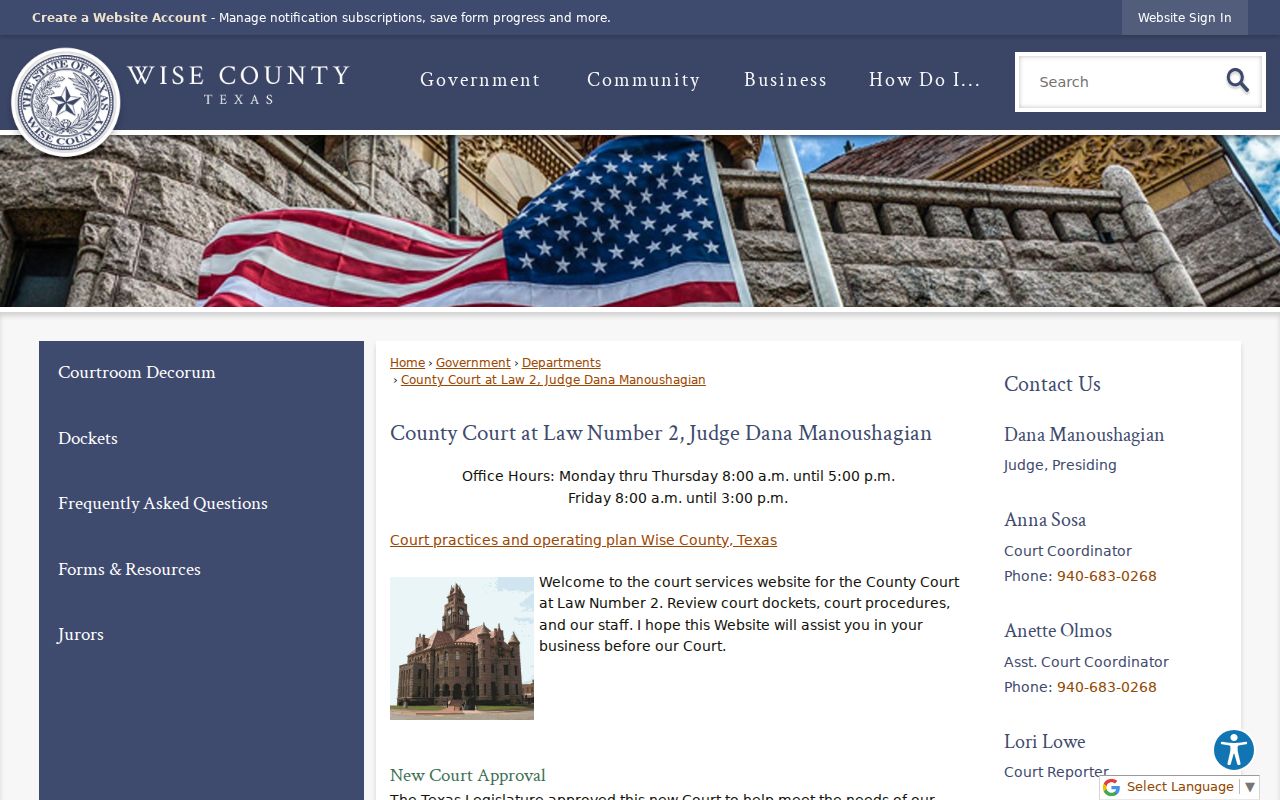
County Court at Law No. 2 concentrates on probate, guardianship, family, and civil matters. Its office sits at 1007 13th Street, Suite 109, Bridgeport. The published phone line is 940-683-0268. Those details matter for a docket search. If you look only at the District Clerk, you can miss a county-law file sitting in Bridgeport. The official court page lists these functions together and gives the local contact route.
A family or probate label does not mean every document is open. Sealed filings, protected identifiers, and confidential case classes can limit what the portal returns for even a public docket.
Civil Case Types on the Docket
Wise County's daily entries use local categories instead of one blanket civil label. Accounts, Contracts, Notes points to debt or contract litigation. Parent Child Relationship and divorce labels mark family matters. Eviction and Small Claims usually mean a Justice Court venue. A category helps route the search, though it says nothing about the current outcome.
| Visible type | Likely court layer | What to inspect next |
|---|---|---|
| Accounts, Contracts, Notes | District or county civil | Petition, answer, motions, judgment |
| Parent Child Relationship | District or county-law family | Public metadata and access limits |
| Divorce Cases / With Children | Family jurisdiction | Settings, signed orders, restricted details |
| Eviction | Justice Court | Precinct, service, hearing, judgment |
| Small Claims | Justice Court | Claim, answer, setting, disposition |
Government Code §25.0003 sets out statutory county-court civil jurisdiction. Limits and assignments can shift, so check the current statute and the Wise court pages before deciding where a new action belongs.
Wise Civil Filings Form a Timeline
Most Wise civil dockets follow a familiar arc. A petition or complaint opens the case, then citation goes out and proof of service comes back. The responding party may answer, counterclaim, or intervene. From there, motions and orders pile up as issues arise, until a setting leads to trial, an agreed resolution, default judgment, nonsuit, or dismissal for want of prosecution.
Civil docket flow: Petition › Citation › Service › Answer › Motion › Order › Hearing › Judgment › Appeal
- Nonsuit
- A plaintiff's dismissal, usually without a decision on the merits unless the order says otherwise.
- DWOP
- Dismissed for want of prosecution; read the exact order and any later reinstatement event.
- Default judgment
- A judgment entered after a required response or appearance failure under the controlling rules.
- Abstract of judgment
- A clerk-issued summary used for certain post-judgment notice and enforcement purposes.
Always read the newest entry first. A proposed order is not a signed one. An appeal or post-judgment writ can keep a docket active long after the original judgment.
Wise Civil Docket Settings and Hearings
A setting only says when the court plans to take up an issue. It is not a ruling. Wise entries include motion hearings, status hearings, announcements, generic hearings, and final divorce settings. Read the proceeding label next to the court, judge, and time. Then check it against the chronological case detail.
The District Clerk cannot set or change a hearing. For the 271st District Court, call the coordinator at 940-627-3200. County Court at Law No. 1 uses 940-627-5005. County Court at Law No. 2 uses 940-683-0268. Rely on the clerk for filings and copies. Depend on the coordinator for the live setting.
Notice is not an order. A notice of setting reports a scheduled event. Only a judge-signed order records the court's direction or ruling.
Note: A reset or continuance on the docket is not the final word. Compare the newest entry with the current calendar and confirm which date actually controls.
When a Wise Civil Case Is Missing
A missing Wise County civil docket result usually has a simple cause. The case may sit in the wrong venue. It might hide behind login-gated Odyssey access, or live in an older paper file. A spelling mismatch can do it too, and legal restriction can block it. Start with the exact cause number. If that fails, try the other county clerk path. The right Justice Court and re:SearchTX are next. Then call or visit the office that holds the file. Bring the party role, an approximate filing date, and the court. Add the document name and a date range. Mail requests should name a specific record. Keep a copy.
You can find the District Clerk at 101 N Trinity Street, Suite 107, Decatur. County Court at Law No. 1 sits at 306 W Main, Decatur. Justice Court offices are split among Decatur, Boyd, and Bridgeport.
Check fees before you send money. The 2026 District Clerk schedule lists a $5 search. Paper pages run $1 each, and electronic pages cost $0.10 with a $1 minimum. Certification adds $5. The schedule also shows an $80 total for an ancillary civil or family motion filing. County Clerk rates may differ, so confirm the right fee first.
Wise Civil Judgments and Appeals
A final judgment resolves some or all claims. Yet the trial docket can keep moving afterward. An abstract, garnishment, or writ may still appear. So can a payment entry, a motion for new trial, or a notice of appeal. Read past the first result that looks final. Consolidation, severance, transfer, and companion-case links can also tuck related events under another cause number.
Most Wise County civil appeals go to the Second Court of Appeals in Fort Worth. The trial docket may show the notice and an appellate cross-reference. The appellate court keeps its own cause, filings, calendar, and decision record.
Wise Civil Docket Access Rules
Texas civil court records are presumed open. Still, a statute, rule, or court order can restrict access. Texas Rule of Civil Procedure 76a sets out the sealing process. It applies to covered civil court records. Texas Rule 12 governs qualifying judicial-record requests. Government Code §552.0035 explains the judiciary gap. It shows why judiciary information is not treated exactly like ordinary executive-branch Public Information Act material.
Juvenile files are confidential. A Wise County standing order dated June 26, 2025 also seals DFPS child-protection matters in the 271st District Court and both County Courts at Law. Nonparty access requires a court order there. Personal identifiers can be redacted even when the rest of a docket stays public.
Access path: Search public metadata, identify the event, ask the responsible clerk about the document, and request certification when an official copy is required.
A portal screen is not a certified record. Only the clerk that maintains the civil case can authenticate the judgment, order, or docket sheet.